



3D printing is no longer just a futuristic hobby or a tool for tinkerers it’s now a key player in industries like manufacturing, healthcare, architecture, and aerospace. Whether you’re a maker designing a prototype, an engineer producing end-use parts, or a business exploring on-demand manufacturing, the material you choose determines everything from print success to product performance.
In this guide, we’ll explore 3D printing materials in depth what they are, how they behave, their pros and cons, and where to use each type. You’ll also learn how to pick the best 3D printing material for your project and understand the growing landscape of the Australia 3D printing materials market.
Why 3D Printing Materials Matters
When you hit “Print” on your 3D printer, it might look like the machine is doing all the work but the real magic lies in the material you choose. Every 3D printing material has its own unique chemistry, melting point, flexibility, and durability. These traits directly affect how your final print performs, looks, and lasts.
Here’s what your material choice impacts:
Mechanical Performance
Determines how much stress, weight, or impact the part can handle. Some materials are tough and rigid (like ABS or Nylon), while others are soft and flexible (like TPU).
Environmental Resistance
Affects how the part performs under heat, UV light, or moisture. For example, PLA works well indoors, while PETG or ASA handle outdoor conditions better.
Aesthetics
Defines the print’s surface finish, texture, and color options. Resin prints often have a smoother finish, while filaments like PLA can show layer lines.
Ease of Printing
Impacts how simple or challenging the printing process is. Some materials print smoothly with minimal warping, while others need heated beds or enclosures for stability.
Functional Suitability
Determines if the part is just for visual display or can be used in real-world applications like prototypes, tools, or mechanical components.
The Major Types of 3D Printing Materials

Over the past decade, the 3D printing materials list has exploded from basic plastics to flexible rubbers, advanced resins, carbon composites, and even metals.
Here’s an overview of the main families:
Thermoplastic Filaments (FDM/FFF)
PLA, ABS, PETG, Nylon, TPU, ASA, Polycarbonate.
Resins (SLA/DLP/MSLA)
Standard, tough, flexible, castable, and bio-compatible resins.
Powders (SLS, MJF, DMLS)
Nylon, alumide, metal powders, ceramics.
Composite & Specialty Materials
Carbon-fiber, glass-fiber, wood, or metal-filled filaments.
Key Material Properties to Compare
Before deciding, always check a material’s:
Property | What It Means | Why It Matters |
| Tensile Strength | How much force before breaking | Key for load-bearing parts |
| Flexibility / Ductility | How easily it bends | Needed for joints, wearables |
| Heat Resistance | When it softens/deforms | Crucial for outdoor or engine use |
| Moisture & UV Resistance | How it handles weathering | For outdoor or marine use |
| Ease of Printing | Risk of warping, adhesion issues | Affects print success rate |
| Surface Finish | Smoothness and aesthetics | Important for visual parts |
| Cost & Availability | Material price and stock | Impacts scalability and sourcing |
Common 3D Printing Materials
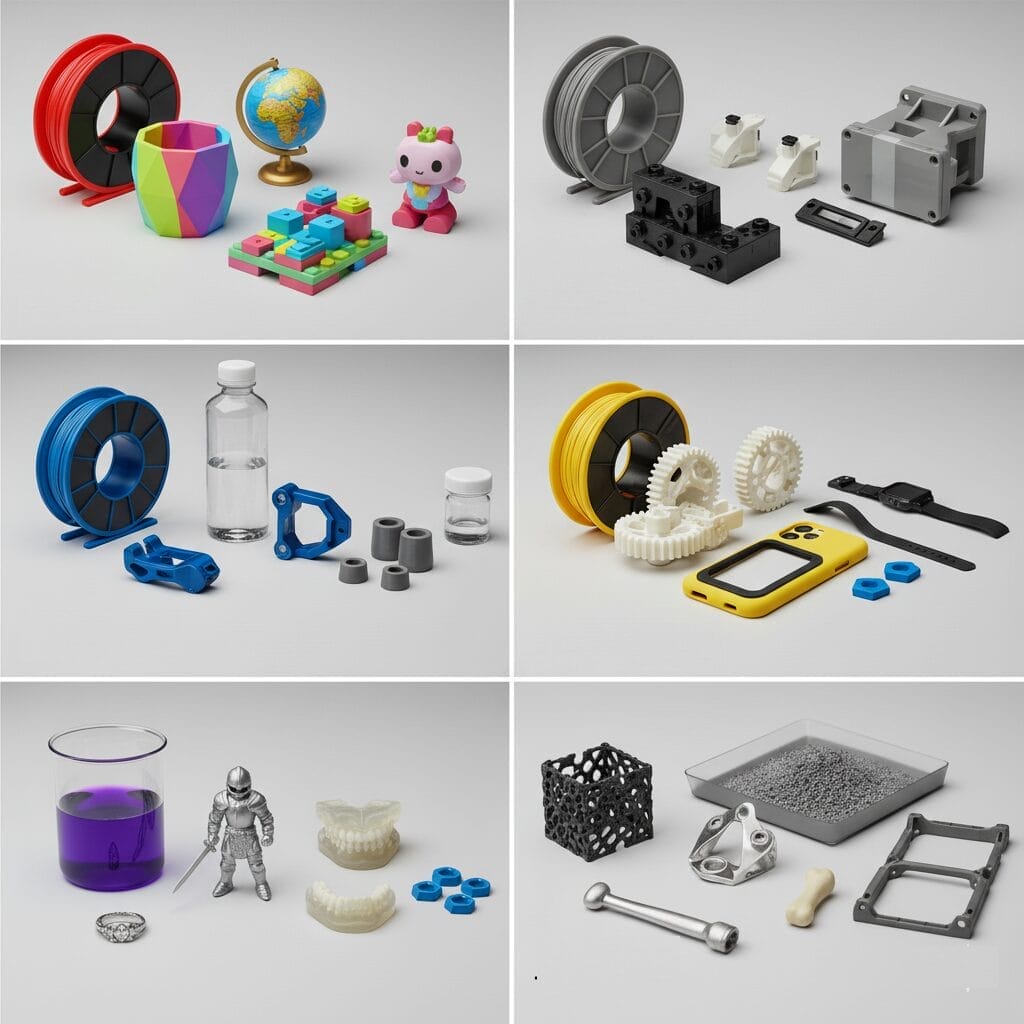
Let’s explore the most widely used materials in the world of 3D printing including their advantages, limitations, and best use cases.
PLA (Polylactic Acid)
PLA is the go-to filament for beginners and educational users.
It’s biodegradable, derived from renewable resources like corn starch, and prints easily at lower temperatures (190–220 °C).
Advantages
- Very easy to print minimal warping.
- Smooth surface finish and good detail.
- Available in many colors.
- Environmentally friendly.
Limitations
- Low heat resistance (~60 °C).
- Brittle and not suitable for mechanical parts.
Best For
Models, decorative items, educational projects, prototypes.
ABS (Acrylonitrile Butadiene Styrene)
ABS is a durable industrial-grade plastic, used for products like LEGO bricks and automotive parts.
Advantages
- High strength and heat resistance.
- Ideal for functional parts and enclosures.
- Can be acetone-smoothed for a glossy finish.
Limitations
- Prone to warping needs heated bed & enclosure.
- Emits fumes during printing (ventilation needed).
- UV-sensitive not ideal for long outdoor use.
Best For
Functional prototypes, mechanical housings, enclosures.
PETG (Polyethylene Terephthalate Glycol)
Often described as the sweet spot between PLA and ABS, PETG combines strength, flexibility, and printability.
Advantages
- Good impact and chemical resistance.
- Low warping, strong layer adhesion.
- Often food-safe and recyclable.
- Performs well outdoors.
Limitations
- Stringing if print settings aren’t optimized.
- Slightly higher print temperature (220–250 °C).
Best For
Mechanical parts, brackets, water bottles, containers.
Nylon (Polyamide)
A favorite in engineering and industrial settings for its excellent mechanical performance.
Advantages
- High strength, flexibility, and wear resistance.
- Excellent chemical resistance (oil, fuel, solvents).
- Tough and reliable for moving parts.
Limitations
- Absorbs moisture needs dry storage.
- Requires high-temperature printer setup.
Best For
Gears, bushings, hinges, mechanical components.
TPU (Thermoplastic Polyurethane)
The go-to flexible 3D printing material, TPU behaves like rubber elastic yet strong.
Advantages
- High elasticity and shock absorption.
- Great for phone cases, gaskets, and footwear.
- Resistant to abrasion and oil.
Limitations
- Tricky to print slower speeds, flexible filament feeding issues.
- Not suitable for rigid structural parts.
Best For
Wearables, flexible joints, vibration dampeners.
Resin (SLA/DLP Printing)
Used in stereolithography and LCD printers, resin materials are liquid photopolymers that harden under UV light.
Advantages
- Ultra-fine details and smooth surface finish.
- Excellent dimensional accuracy.
- Many variants: standard, tough, flexible, castable, bio-resins.
Limitations
- Brittle unless using tough resin.
- Post-processing required (washing, curing).
- Smaller build volume than FDM printers.
Best For
Miniatures, jewelry, dental models, medical prototypes.
Metal & Powder-Based 3D Printing Materials
Industrial-grade 3D printing uses powdered materials fused by lasers or binders.
Examples
- Stainless Steel : Strong, durable, corrosion-resistant.
- Titanium : Lightweight and biocompatible (used in aerospace & medical).
- Aluminum : Good strength-to-weight ratio, ideal for structural components.
- Nylon Powder (SLS/MJF) : Used in production for durable plastic parts.
Best For
Aerospace components, automotive brackets, medical implants, and production-grade end-use parts.
Choosing the Right Material: A Step-by-Step Approach
Selecting the right 3D printing material can make all the difference between a successful print and a failed one. Follow this structured approach to find the best filament for your 3D printing project.
Define Your Purpose
Before you pick a material, clearly define what the printed object will do.
Decorative models: Choose easy-to-print filaments like PLA for smooth finishes.
Functional parts: Use PETG or ABS for strength and durability.
Flexible components: Go with TPU or TPE for elasticity.
Industrial use: Consider Nylon or Polycarbonate (PC) for superior mechanical performance.
Check Environmental Exposure
Different 3D printing materials perform differently in various environments.
Indoor parts can use PLA or resin with minimal concern.
Outdoor parts should resist UV light, heat, and moisture use ASA, PETG, or Nylon.
High-heat applications need materials with a higher glass transition temperature (like PC or ABS).
Assess Printer Capabilities
Not all printers support every filament type.
Check your printer’s nozzle temperature range and heated bed capacity.
Some advanced filaments (like Nylon or PC) need enclosed chambers to prevent warping.
Basic printers handle PLA, PETG, and TPU easily perfect for most home users.
Compare Mechanical Properties
Each material offers unique mechanical strengths.
For toughness and impact resistance, choose ABS, PETG, or Nylon.
For detail and smooth surface finish, resin or PLA are best.
For elasticity or flexibility, TPU is ideal.
Consider Cost & Availability
Material choice often comes down to budget and supply.
PLA and PETG are affordable and widely available, perfect for everyday use.
Engineering-grade filaments (like PC or Carbon Fiber Nylon) are more expensive but offer premium performance.
Factor Post-Processing Needs
Some 3D printing materials require extra steps after printing.
Resin prints need washing and UV curing.
ABS can be acetone-smoothed for a polished look.
PLA and PETG often need light sanding or painting.
Evaluate Long-Term Durability
Finally, consider how your 3D print will perform over time.
Functional or load-bearing parts should use durable materials like PETG, ABS, or Nylon.
High-temperature environments require Polycarbonate or ASA.
Display models can use less durable but visually appealing options like PLA or resin.
The Australia 3D Printing Materials Market
Australia’s 3D printing landscape is growing fast both in consumer and industrial sectors.
As businesses adopt additive manufacturing, local material demand is rising for both imported and regionally produced filaments and resins.
Key insights:
- Local brands like Aurarum, 3D Fillies, and Bilby3D offer high-quality, locally stocked filaments.
- Import costs and currency fluctuations affect pricing and availability.
- The aerospace and defense industries are driving demand for metal powders and engineering-grade polymers.
- Environmental awareness is pushing more users toward biodegradable materials like PLA and recyclable PETG.
So, when searching for “3D printing materials plastic Australia,” consider regional distributors they often stock temperature-stable materials suited to local climates.
Material vs. Key Properties
Material | Strength | Ease of Printing | Heat Resistance | Best Use |
| PLA | Moderate, brittle | Very easy | Low (55–65 °C) | Models, décor |
| ABS | Tough, durable | Moderate | High (90–100 °C) | Functional parts |
| PETG | Strong + flexible | Easy | Moderate | Outdoor, utility |
| Nylon | Very strong | Hard | High | Mechanical parts |
| TPU | Flexible | Medium | Low–moderate | Wearables, gaskets |
| Resin | Detailed | Moderate | Varies | Miniatures, dental |
| Composite (CF/GF) | Rigid, stiff | Hard | High | Structural parts |
Latest Developments & Trends in 3D Printing Materials
The world of 3D printing materials is evolving fast. Here are a few trends shaping the future:
- Sustainable Filaments: Bioplastics, recycled PLA, and ocean-sourced materials are gaining traction.
- High-Performance Polymers: Materials like PEEK, ULTEM, and PA12 are entering mainstream use for aerospace and automotive.
- Metal 3D Printing Growth: More accessible systems for small businesses are emerging.
- Resin Innovation: Flexible, bio-compatible, and hybrid resins are improving durability and safety.
FAQs
Which 3D printing material is best for beginners?
PLA (Polylactic Acid) is the safest choice for beginners it is easy to print, has minimal warping, and is low cost. If you need a little more strength, PETG (Polyethylene Terephthalate Glycol) can be the second choice.
What is the best 3D printing material for strength and durability?
For strength and durability (functional parts), Nylon (Polyamide) or reinforced filaments (like carbon or glass fiber filled) or engineering plastics like PC (Polycarbonate) or PEEK (Polyether Ether Ketone) are among the best. Resin or basic PLA would be less suitable.
Why choose PETG over PLA?
PETG offers better impact resistance and flexibility, along with a less brittle failure mode compared to PLA. If the part is functional and requires some robustness, PETG is the better option.
Can I print with ABS on any printer?
No ABS has warping issues and releases fumes, so a closed-chamber printer and good ventilation are highly recommended.