



In the world of additive manufacturing, MJF 3D printing (Multi Jet Fusion) has rapidly gained attention for its speed, surface quality, and production-ready performance. Developed by HP, this innovative process redefines how industrial parts are made combining fine detail, strength, and scalability like never before. Unlike traditional 3D printing methods, HP MJF 3D printing uses fusing and detailing agents with infrared energy to build parts faster and with consistent accuracy. Here’s a complete step-by-step look at how 3D printing using MJF works, what makes it unique, and where it stands against other technologies like SLS and FDM.
What Is MJF 3D Printing?
MJF (Multi Jet Fusion) is an advanced 3d printing technology powder-bed fusion process developed by HP for producing functional, end-use 3D printed parts. In 3D printing MJF, an inkjet array selectively deposits fusing and detailing agents onto a powder layer, which is then fused using infrared light. This results in high-strength, fine-detailed parts without the need for support structures. Because it builds objects layer by layer inside a powder bed, MJF 3D printing delivers excellent isotropic mechanical properties and dimensional accuracy.
Brief History
HP introduced Multi Jet Fusion in 2016, revolutionizing industrial 3D printing. Before MJF, laser-based systems like SLS 3D printing dominated polymer powder-bed technologies. HP’s approach replaced the laser with precision inkjet heads and thermal energy, allowing faster layer fusion and scalable production. Today, HP MJF 3D printing powers industries from aerospace to healthcare, enabling rapid prototyping and low-volume manufacturing with production-grade quality.
The Core Principle
At its core, MJF 3D printing works through selective agent deposition and infrared fusion.
Here’s how it operates step by step:
- A thin layer of powder (usually nylon or PA12) is spread evenly across the build platform.
- HP’s inkjet heads selectively deposit fusing agents where material should solidify.
- Detailing agents are applied to refine edges and prevent over-sintering.
- A heat source (infrared lamp) passes over the surface, fusing only the areas with the fusing agent.
- The build platform lowers, a new powder layer is spread, and the cycle repeats until the object is complete.
Because the surrounding powder supports the part during printing, no support structures are required one of MJF’s biggest advantages over FDM 3D printing.
Other supporting mechanisms include:
- Preheating the build chamber to stabilize temperatures.
- Using fine, consistent powders for optimal fusion.
- Maintaining controlled airflow and thermal balance to prevent warping.
This process results in strong, uniform, and highly detailed 3D printed parts.
The Complete MJF 3D Printing Process
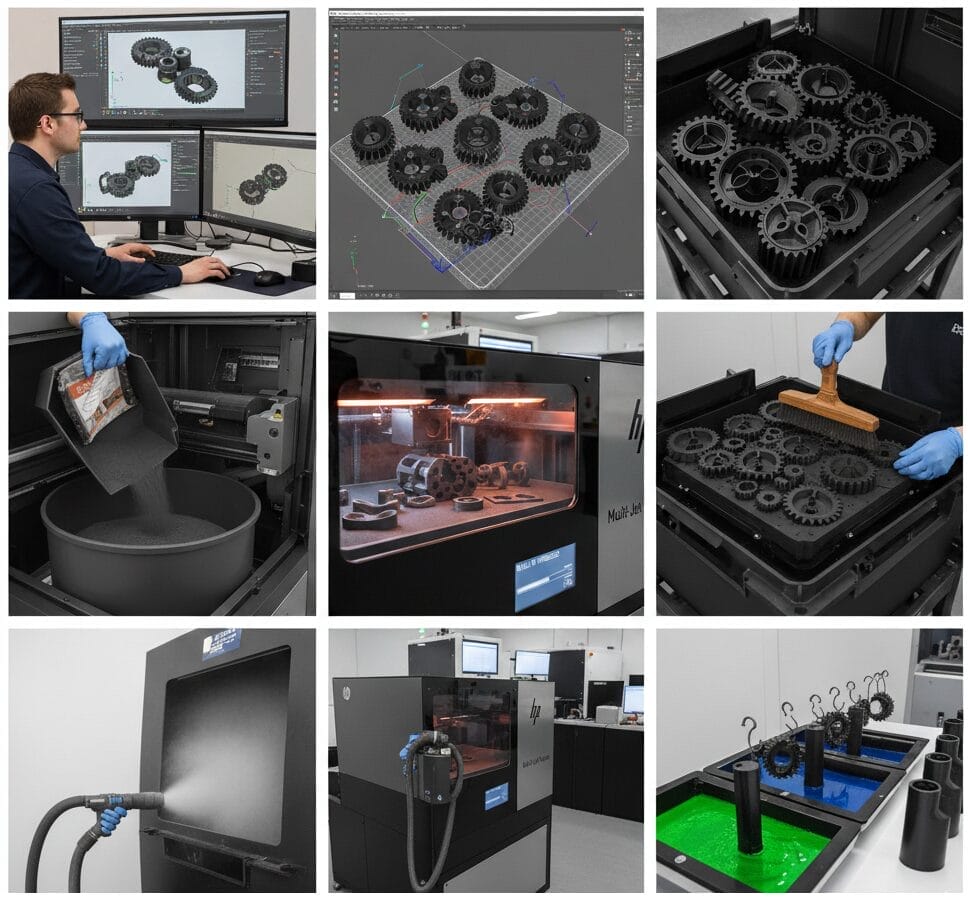
Below is the full step-by-step workflow of the MJF 3D printing process from digital design to finished product.
Designing the 3D Model
- Create a watertight CAD model using software like Solid Works or Fusion 360.
- Optimize for MJF 3D printing add proper wall thickness, spacing, and drain holes if needed.
- Export your model in .STL or .3MF format.
Slicing & Pre-processing
- Import the design into HP’s build preparation software.
- Define layer thickness, build orientation, and part packing density.
- The software generates the agent application paths for each layer.
Printer Setup
- Fill the powder hopper with selected MJF 3D printing material (PA12, PA11, or TPU).
- Calibrate temperature and agent deposition heads.
- Preheat the chamber to ensure uniform fusion conditions.
Layer-by-Layer Printing
- Powder is spread in thin layers (typically 80 microns).
- Fusing and detailing agents are selectively deposited.
- The heating unit fuses the targeted regions.
- The process repeats until the part is complete.
Cooling & Part Removal
- After printing, the powder bed cools gradually to prevent internal stresses.
- Once cooled, parts are removed from the surrounding unfused powder.
Post-Processing
- Depowdering: Loose powder is cleaned off with air or blasting.
- Bead blasting or tumbling: Smooths the surface finish.
- Dyeing / Coloring: Nylon parts can be dyed for aesthetics.
- Vapor smoothing or sealing: Optional finishing for smoother surfaces.
- Machining / inspection: Final checks for tolerance and accuracy.
These stages define a complete 3D printing MJF workflow from idea to finished functional part.
MJF 3D Printing Materials & Their Uses
A major advantage of MJF technology in 3D printing is its wide range of compatible thermoplastic materials.
Below are commonly used MJF 3D printing materials and their applications:
| Material Type | Properties / Advantages | Common Use Cases |
| Nylon (PA12, PA11) | Excellent strength, toughness, and heat resistance | Functional prototypes, mechanical parts, end-use components |
| Glass-Filled Nylon | Higher stiffness and temperature resistance | Structural parts, load-bearing applications |
| Carbon-Filled Nylon | Lightweight yet rigid | Aerospace, automotive components |
| TPU (Thermoplastic Polyurethane) | Flexible, impact-resistant, and durable | Seals, gaskets, flexible joints |
| Polypropylene (PP) | Chemical resistance, low density | Containers, housings, functional prototypes |
The choice of MJF 3D printing material depends on part requirements flexibility, strength, heat performance, or visual quality.
Key Parameters That Affect MJF Print Quality
To achieve the best output with HP MJF 3D printing, these process parameters are crucial:
- Layer Thickness: Commonly 60–100 microns; thinner layers enhance surface finish.
- Agent Deposition Accuracy: Affects fine detail and edge definition.
- Powder Bed Temperature: Should remain near the melting point for consistent fusion.
- Fusing Agent Concentration: Determines strength and density of printed regions.
- Build Orientation: Impacts dimensional accuracy and surface texture.
- Cooling Rate: Improper cooling can cause warping or internal stress.
- Powder Reuse Ratio: Managing refresh powder ensures consistent quality.
- Post-Processing Techniques: Blasting, dyeing, and sealing all influence final aesthetics.
Fine-tuning these variables ensures professional-quality 3D print MJF parts.
Advantages of MJF 3D Printing

High-Speed Printing
MJF 3D printing builds each layer in a single pass using infrared heating and fusing agents.This makes it significantly faster than most 3D printing methods like SLS or FDM, ideal for both prototyping and production runs.
Excellent Surface Finish
Thanks to HP’s detailing agent, MJF-printed parts have a smoother surface and sharper edge definition compared to SLS or FDM parts. Minimal post-processing is needed to achieve a professional look.
Superior Mechanical Properties
MJF technology produces parts with nearly isotropic mechanical strength meaning the parts are strong in all directions.This makes them perfect for functional prototypes, durable components, and even small-batch production parts.
No Support Structures Required
During the MJF 3D printing process, the surrounding powder naturally supports overhangs and complex geometries.This eliminates the need for additional support structures, saving material and post-processing time.
Scalable Batch Production
Multiple parts can be efficiently nested and printed together in one build volume. This makes MJF 3D printing services highly cost-effective for small-batch or on-demand manufacturing.
Material Reusability
Unused powder from a build can be refreshed and reused, reducing material waste and lowering production costs. HP’s controlled powder management helps maintain consistent part quality over multiple print cycles.
Consistent Quality and Repeatability
Automated control of agents, heat distribution, and powder layering ensures that every build maintains the same precision and mechanical properties. This reliability makes HP MJF 3D printing one of the most dependable industrial-grade 3D printing options available today.
Limitations & Challenges of MJF 3D Printing
Powder Handling:
Fine powders in MJF 3D printing require careful handling and controlled environments to prevent contamination and ensure safety.
Color Options:
While parts can be dyed after printing, raw MJF 3D prints usually come out gray. Full-color printing is limited to certain HP models.
High Equipment Cost:
Industrial HP MJF 3D printers are expensive, making them less accessible for small businesses, though many use MJF 3D printing services instead.
Thermal Distortion:
Uneven cooling can cause minor warping in large parts, though proper temperature control reduces this risk.
Limited Material Variety:
Most MJF 3D printing materials are nylon or TPU-based, offering good performance but fewer options compared to other technologies.
Despite these, the advantages often outweigh the drawbacks especially in professional applications.
Applications of MJF 3D Printing
MJF technology 3D printing is used across a wide range of industries:
Prototyping & Product Development:
Strong prototypes for fit, function, and field testing.
Low-Volume Production:
Ideal for custom batches without costly molds.
Aerospace & Automotive:
Lightweight ducts, brackets, housings, and fixtures.
Medical & Healthcare:
Prosthetics, orthotic components, surgical tools.
Consumer Products:
Functional housings, handles, and casings.
Flexible Parts:
MJF TPU 3D printing for seals, shock absorbers, and wearable components.
On-Demand Manufacturing:
Businesses use MJF 3D printing services for quick, custom part delivery.
FAQs
What materials are used in MJF 3D printing?
Common MJF 3D printing materials include PA12 and PA11 nylon, TPU (flexible), and glass- or carbon-filled composites. These materials offer strong, functional, and durable parts suitable for prototyping and end-use applications.
How is MJF 3D printing different from SLS 3D printing?
In SLS, a laser sinters powder point by point, while MJF 3D printing uses inkjet heads to apply fusing agents over entire layers at once. This gives MJF faster build speeds, better surface detail, and more consistent mechanical properties key advantages in the MJF vs SLS 3D printing technology debate.
Is MJF 3D printing suitable for production or just prototyping?
Yes, HP MJF 3D printing is ideal for both. It offers production-grade quality with fine detail and repeatability, making it perfect for small-batch manufacturing and functional prototypes alike.
Can MJF-printed parts be colored or finished?
Raw MJF 3D prints come out gray, but parts can be dyed, painted, or coated for aesthetic purposes. Some advanced HP systems even support full-color 3D printing using MJF for design or branding needs.