



3D printing has rapidly evolved, and two technologies FDM (Fused Deposition Modeling) and MJF (Multi Jet Fusion) stand out for producing strong, functional parts. Whether you’re picking a machine for your business or simply trying to understand the difference between FDM vs MJF, this guide explains everything clearly: print quality, strength, speed, cost, materials, workflow, surface finish, and real-world applications.
This detailed comparison will help you decide which one fits your needs best.
What is FDM 3D Printing?
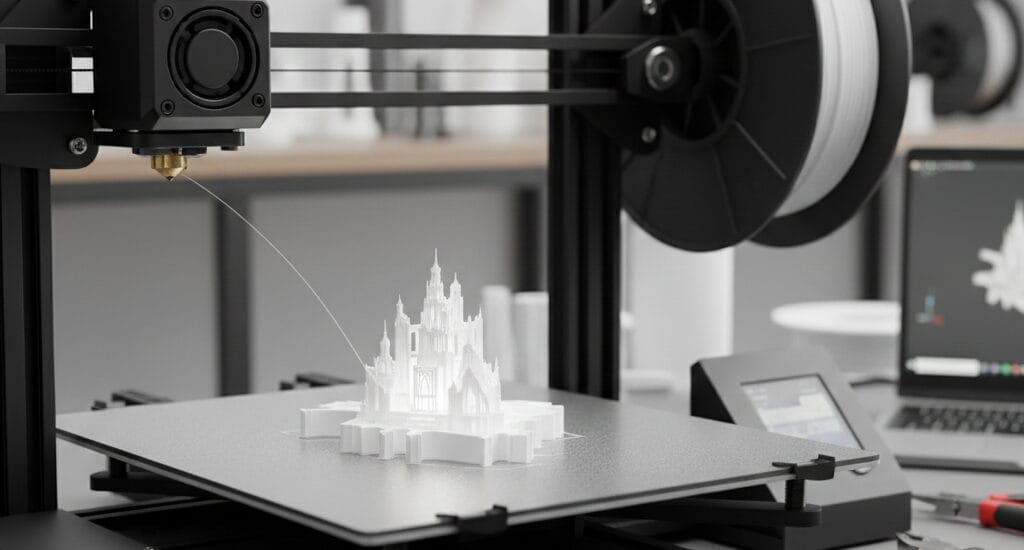
FDM 3D printing, also known as FFF (Fused Filament Fabrication), is one of the most common and beginner-friendly 3D printing technology. It uses solid thermoplastic filament like PLA, PETG, ABS, or Nylon which is melted and extruded layer by layer.
Think of it as a controlled, ultra-precise hot glue gun that draws your part one layer at a time.
How FDM Works
A spool of filament (PLA, ABS, PETG, TPU, Nylon, etc.) is heated in a nozzle.
The printer extrudes melted plastic layer-by-layer.
The material cools, hardens, and builds the final shape.
Advantages of FDM
Very affordable materials
Large build volumes available
Good mechanical strength (varies with filament type)
Great for functional parts, jigs, fixtures, and prototypes
Easy workflow with minimal post-processing
Limitations of FDM
Visible layer lines
Lower detail compared to resin or MJF
Mechanical strength depends on layer bonding
Dimensional accuracy can vary
FDM is ideal for functional prototypes, engineering parts, large objects, and low-cost production.
What is MJF 3D Printing?

MJF 3D printing is an industrial 3D printing technology developed by HP. It uses powder-based Nylon material, which is fused by an infrared lamp after being coated with fusing agents. Unlike FDM, MJF does not extrude material instead, it fuses entire layers at once.
This allows it to produce highly accurate, strong, and repeatable parts ideal for manufacturing.
How MJF Works
A thin layer of Nylon powder (usually PA12 or PA11) is spread on the print bed.
A printhead jets fusing & detailing agents onto the powder.
An infrared lamp passes over, solidifying only the jetted regions.
The process repeats layer-by-layer until the part is complete.
Advantages of MJF
Excellent strength and isotropic mechanical properties
Highly accurate and consistent professional results
Smooth, uniform surface with minimal layer visibility
Ideal for batch production and functional components
No support structures needed
Limitations of MJF
Machines and materials are expensive
Requires powder-handling equipment
Limited material options (mostly Nylon-based)
Post-processing (depowdering) required
FDM vs MJF 3D Printing: Detailed Comparison
Looking to understand MJF vs FDM more clearly? Here’s a deep breakdown covering quality, strength, speed, materials, and applications so you can choose the right technology for your needs.
Print Quality: FDM vs MJF
FDM 3D Printing Quality
Prints thermoplastic filaments layer-by-layer
Visible layer lines are common
Good for general prototypes
Struggles with very fine details
Surface quality depends heavily on calibration
MJF 3D Printing Quality
Uses powder fused by an infrared lamp
Much smoother surface finish than FDM
Excellent detail and dimensional precision
Professional-grade accuracy suitable for end-use parts
Isotropic strength (almost equal in all directions)
Print Strength: MJF vs FDM
FDM Strength
Strength depends on filament type and layer adhesion
PLA = rigid but brittle
PETG = tough and impact-resistant
ABS/ASA = durable & heat-resistant
Nylon / CF-Nylon = strongest FDM filaments
Weakest point: layer separation under stress
MJF Strength
Uses Nylon powder (PA12, PA11)
Exceptional tensile & impact strength
Strong in all directions (isotropic)
Ideal for real-world mechanical parts
More durable than SLA and often stronger than standard FDM
Print Speed: FDM vs MJF
FDM Speed
Faster for single large objects
Slower for small detailed prints
Complex geometry increases print time
MJF Speed
Prints entire layers at once
Print time does NOT change with complexity
Extremely fast for batch production
Material Options: FDM vs MJF
FDM Materials
PLA, PETG, ABS, ASA
TPU (flexible)
Nylon
Carbon fiber composites
Wood-filled, metal-filled, glitter, etc.
Extremely diverse and budget-friendly options.
MJF Materials
Primarily Nylon PA12 (standard)
PA11 for higher flexibility
Glass-filled (PA12 GF)
TPU (in some MJF systems)
Industrial-grade powders
Material variety is limited but very high performance.
FDM vs MJF Surface Finish
FDM
Visible layer lines
Rougher surfaces
May require sanding, filing, or smoothing
MJF
Smooth, uniform surfaces
Almost no visible layers
Light post-processing needed (bead blasting, dyeing)
FDM vs MJF for Miniatures & Detailed Models
MJF for Miniatures
Clean surfaces
Excellent accuracy
Handles small details well
Very durable for handling/production
FDM for Miniatures
Visible lines reduce clarity
Not ideal for tiny details
Better for large props or display pieces
FDM vs MJF for Business & Industrial Uses
Choose FDM If You Need:
Low-cost prototypes
Large functional parts
Budget-friendly production
Simple engineering applications
Material experimentation
Choose MJF If You Need:
End-use manufacturing
High-strength functional parts
Batch production
Industrial-grade accuracy
Consistent mechanical performance
FDM vs MJF: Full Technology Overview
FDM
- How it works: Melts filament and extrudes it layer-by-layer.
- Strengths: Affordable, large prints, wide material choices.
- Cost & Size: Low material cost, cheap machines.
- Limitations: Visible layer lines, lower precision.
MJF
- How it works: Uses powder + fusing agent + infrared lamp.
- Strengths: Strong, accurate, fast, industrial-grade parts.
- Cost & Size: Expensive machines but great for production.
- Limitations: Limited materials, powder handling required.
FDM vs MJF: Side-by-Side Comparison
| Feature | FDM | MJF |
|---|---|---|
| Quality | Good | Excellent |
| Detail Level | Moderate | Very High |
| Strength | Depends on filament | Industrial-grade strong |
| Speed | Moderate | Very fast (batch printing) |
| Material Cost | Low | Medium–High |
| Machine Cost | Low | Very high |
| Surface Finish | Visible lines | Smooth, uniform |
| Best For | Prototypes & large parts | Functional end-use parts |
FAQs
Which is better FDM or MJF ?
The best choice depends on your needs. MJF produces stronger, smoother, and more accurate parts, making it ideal for end-use manufacturing and engineering applications. FDM is cheaper and great for prototypes, hobby printing, and large objects.
Is MJF stronger than FDM?
In most cases, MJF Nylon prints are stronger, more durable, and more isotropic than standard FDM filaments. Even strong FDM materials like Nylon or PETG cannot match the consistency of MJF.
Is MJF more expensive than FDM?
Yes, due to industrial machines, powder 3D printing materials, and post-processing. FDM is significantly more affordable for beginners and small workshops.
For 3D printing projects, quotes and more information visit KAD 3D